
Investment Weekly: Climbing the wall of worry

12 October 2026
Key takeaways
-
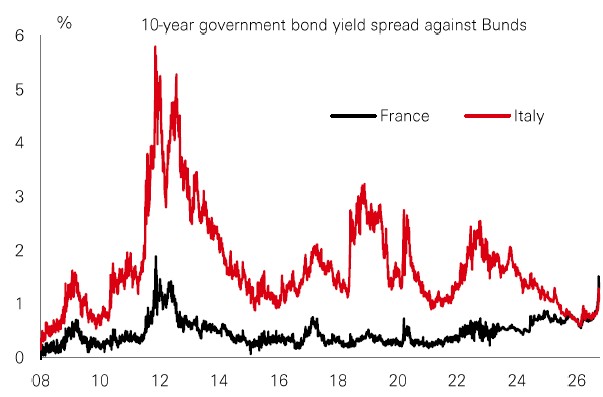
The 10-year OAT–Bund spread has widened to its highest level in 15 years. This comes as persistent budget deficits, elevated public debt and parliamentary fragmentation fuel doubts about the government’s capacity to deliver fiscal consolidation ahead of the 2027 presidential election.
-
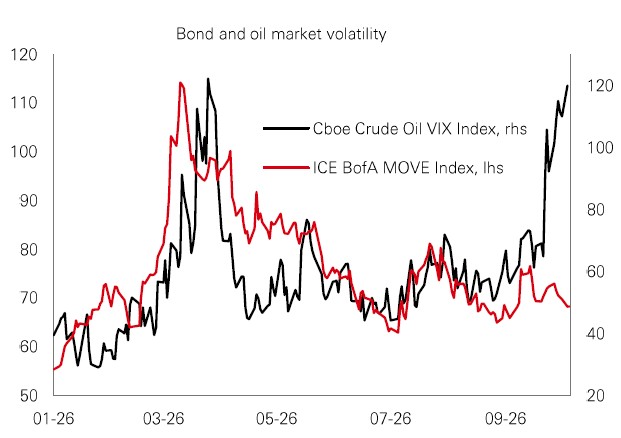
One of the major factors behind 2026’s bond market shock has been the surge in oil prices caused by the Iran conflict. This is seen in this year’s overlapping movements between implied measures of bond and oil market volatility as measured by the MOVE and oil VIX indices, respectively.
-
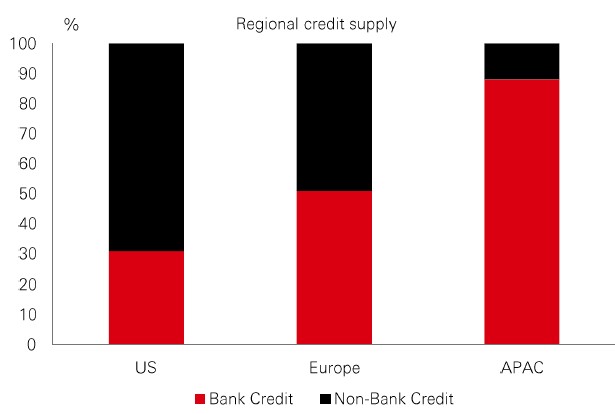
Despite generating roughly 40% of global GDP and 60% of forecasted future economic growth, Asia accounts for just 5% of global private credit assets. This stark imbalance exists because Asian lending remains fiercely bank-led, representing 88% of the regional credit supply.
Chart of the week – Climbing the wall of worry
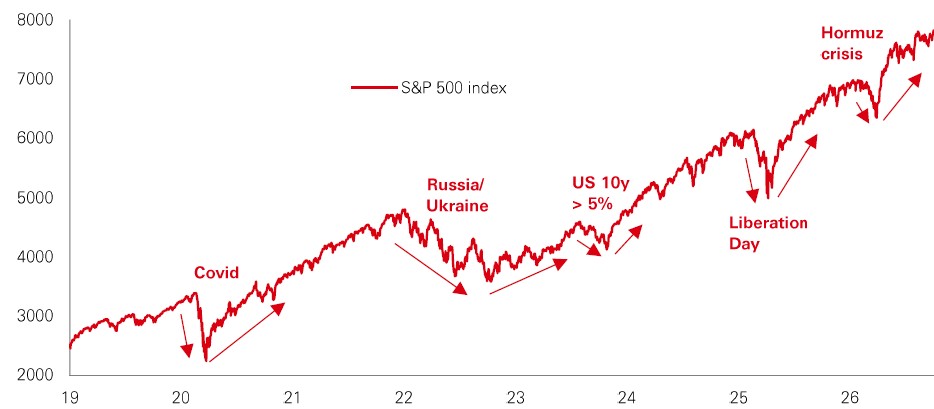
Markets have faced greater uncertainty over the past few years, contending with a once-in-a-century pandemic, commodity price spikes, and a breakdown in the established rules-based global order. Yet they have shown impressive resilience. This is being demonstrated once again as the S&P 500 inches toward the 8000 level despite the headwinds of high oil prices, a hawkish Fed, surging bond yields and an increasing focus on the existential risks posed by AI.
The Covid recovery was about huge doses of policy stimulus. The 2022 commodity shock dissipated as global economies rewired supply chains. And the post-Liberation Day experience has been a textbook example of fleeting geopolitical risk premiums. But exceptional profit growth is now doing the heavy lifting. Consensus profit growth for 2026e – 36% globally and 34% in the US – is three to four times its long-run average.
This doesn’t necessarily mean the coast is clear. A market derating tells us that higher bond yields and geopolitics do matter. EPS growth might cool in 2027 and could be downgraded if the AI capex bonanza disappoints. It is also concentrated, mainly in tech and commodities. A broadening of profit growth will be an important theme for next year.
What’s more, sticky bond yields pose a constant threat to the valuation arithmetic – the opportunity cost of buying stocks is now higher. We are seeing pockets of weakness in more rate sensitive parts of the market – the Russell 2000 is down by nearly 10% from its August highs, and lower-tier credit spreads have gapped out. But for the time being broader corporate fundamentals look robust enough to weather the storm.
Market Spotlight
Chinese stocks: the next big hit?
When a legendary pop star hits a career slump, casual listeners simply tune out until the next big single arrives. Jumping back on the bandwagon late costs them nothing. In public markets, you don’t have that luxury. By the time a turnaround is obvious, the rebound has happened and the easy gains are gone.
Could Chinese stocks be staging that very comeback? While near-term sentiment remains weighed down by soft domestic demand, and perhaps limited evidence of AI monetisation, underlying fundamentals are turning. The GDP deflator has finally swung positive after three years of deflation, supported by Beijing’s "anti-involution" policies curbing ruinous price wars. Meanwhile, corporate earnings are tracking low double-digit growth, led by strategic onshore sectors.
Crucially, Chinese stocks may offer an attractive hedge against global AI trades. Supported by tech localisation and high-end manufacturing, China’s tech ecosystem operates on its own cycle, leaving earnings far less exposed to US hyperscaler capex risks.
The value of investments and any income from them can go down as well as up and investors may not get back the amount originally invested. The level of yield is not guaranteed and may rise or fall in the future. Past performance does not predict future returns. For informational purposes only and should not be construed as a recommendation to invest in the specific company, country, product, strategy, sector, or security. Diversification does not ensure a profit or protect against loss. Any views expressed were held at the time of preparation and are subject to change without notice. Any forecast, projection or target where provided is indicative only and is not guaranteed in any way. Index returns assume reinvestment of all distributions and do not reflect fees or expenses. You cannot invest directly in an index. Source: HSBC Asset Management, Factset, Bloomberg, Macrobond. Data as at 7.30am UK time 09 October 2026.
Lens on…
Not-so-mighty OATs
Unlike the hearty breakfast staple guaranteed to keep you strong, French OATs are proving to be a weak diet for investors right now. The 10-year OAT–Bund spread has widened to its highest level in 15 years. This comes as persistent budget deficits, elevated public debt and parliamentary fragmentation fuel doubts about the government’s capacity to deliver fiscal consolidation ahead of the 2027 presidential election. There is an argument that the bond market is self-regulating. Tighter financial conditions can constrain growth, reducing the ECB’s willingness to raise interest rates. Markets have already scaled back expectations for further rate hikes. What’s more, the crisis could prompt politicians to force through unpopular spending cuts, even amid domestic unrest. The ECB also has its bond-buying tool – the Transmission Protection Instrument – to help contain disorderly market dynamics. |
At current yields, French bonds offer attractive carry and potential capital gains if credible fiscal plans emerge. But for the time being, there remains a risk of further spread widening and volatility.
Oil’s well that ends well?
One of the major factors behind 2026’s bond market shock has been the surge in oil prices caused by the Iran conflict. This is seen in this year’s overlapping movements between implied measures of bond and oil market volatility as measured by the MOVE and oil VIX indices, respectively. But what’s interesting is the recent disconnection between these volatility measures: bond markets have continued to sell off and remain choppy even though oil prices have settled. This may be because the initial leg higher in yields has created its own problems. A hawkish pivot by Western central banks – which have maintained their inflation-fighting credibility as evidenced by stable inflation expectations – has pushed real yields higher and shifted investors’ focus to underlying debt sustainability. |
So, lower oil prices could still help bring yields down. But there are ongoing pressures on governments to keep spending – many of which are related to the same messy geopolitics that created the current situation in the first place. And with hyperscaler debt issuance likely to remain massive, investors shouldn’t expect falling oil prices to be a silver bullet.
A loan in Asia
Despite generating roughly 40% of global GDP and 60% of forecasted future economic growth, Asia accounts for just 5% of global private credit assets. This stark imbalance exists because Asian lending remains fiercely bank-led, representing 88% of the regional credit supply. Traditional banks favour large corporates with conventional borrowing needs, leaving dynamic, mid-market businesses starved of flexible, transitional capital. For alternative lenders, this supply-demand mismatch presents a potential opportunity. With only 744 private credit funds operating in Asia – compared with over 2,100 in the US – the market is notably uncrowded. Consequently, lenders can command yields 2% to 4% higher than those on comparable Western deals, often alongside shorter durations and enhanced collateral protections. |
Ultimately, heavy concentration in US and European assets leaves investors exposed to correlated economic cycles and borrower profiles. Increasing allocations to Asia can provide diversification that modern portfolios are increasingly struggling to find.
Past performance does not predict future returns. The level of yield is not guaranteed and may rise or fall in the future. For informational purposes only and should not be construed as a recommendation to invest in the specific country, product, strategy, sector, or security. Diversification does not ensure a profit or protect against loss. Any views expressed were held at the time of preparation and are subject to change without notice. Index returns assume reinvestment of all distributions and do not reflect fees or expenses. You cannot invest directly in an index. Any forecast, projection or target where provided is indicative only and is not guaranteed in any way. Source: HSBC Asset Management. Macrobond, Bloomberg, Refinitiv, FactSet. Data as at 7.30am UK time 09 October 2026.
Key Events and Data Releases
Last week

This week ahead

For informational purposes only and should not be construed as a recommendation to invest in the specific country, product, strategy, sector or security. Any views expressed were held at the time of preparation and are subject to change without notice. Any forecast, projection or target where provided is indicative only and is not guaranteed in any way. Index returns assume reinvestment of all distributions and do not reflect fees or expenses. You cannot invest directly in an index. Source: HSBC Asset Management. Data as at 7.30am UK time 09 October 2026.
Market review
Global equity markets traded mixed amid persistent concerns over elevated yields and energy costs. US Treasury yields retreated following solid Treasury debt auctions, while fiscal concerns continued to weigh on French OATs, and UK gilt yields also moved higher. US equities were broadly stable, with the S&P 500 and Nasdaq testing fresh highs ahead of the Q3 earnings season, despite continued weakness in the interest-rate-sensitive Russell 2000. Most European indices were set to close lower amid growing concerns over the economic outlook, while the Nikkei 225 was range-bound. Among EM equities, Brazilian stocks led the gains amid growing fiscal optimism, whereas Asian markets mostly declined. The Kospi led the losses despite strong Q3 chip earnings, while the Shanghai Composite declined after the country returned from the holidays. In FX, the dollar index was little changed, while major currencies diverged.
Share

Related Insights


Disclaimer
This document or video is prepared by The Hongkong and Shanghai Banking Corporation Limited (‘HBAP’), 1 Queen’s Road Central, Hong Kong. HBAP is incorporated in Hong Kong and is part of the HSBC Group. This document or video is distributed and/or made available by HSBC Bank (China) Company Limited, HSBC Bank (Singapore) Limited, HSBC Bank Middle East Limited (UAE), HSBC UK Bank Plc, HSBC Bank Malaysia Berhad (198401015221 (127776-V))/HSBC Amanah Malaysia Berhad (20080100642 1 (807705-X)), HSBC Bank (Taiwan) Limited, HSBC Bank plc, Jersey Branch, HSBC Bank plc, Guernsey Branch, HSBC Bank plc in the Isle of Man, HSBC Continental Europe, Greece, The Hongkong and Shanghai Banking Corporation Limited, India (HSBC India), HSBC Bank (Vietnam) Limited, PT Bank HSBC Indonesia (HBID), HSBC Bank (Uruguay) S.A. (HSBC Uruguay is authorised and oversought by Banco Central del Uruguay), The Hongkong and Shanghai Banking Corporation Limited – Philippine Branch, HSBC Investment and Insurance Brokerage, Philippines Inc, HSBC Insurance Brokerage Company Limited, HSBC Mexico, S.A. Multiple Banking Institution HSBC Financial Group (collectively, the “Distributors”) and HSBC Bank Middle East Limited Qatar Branch, P.O. Box 57, Doha, Qatar (regulated by Qatar Central Bank for the purpose of this promotion and lead regulated by the Dubai Financial Services Authority) to their respective clients. This document or video is for general circulation and information purposes only.
The contents of this document or video may not be reproduced or further distributed to any person or entity, whether in whole or in part, for any purpose. This document or video must not be distributed in any jurisdiction where its distribution is unlawful. All non-authorised reproduction or use of this document or video will be the responsibility of the user and may lead to legal proceedings. The material contained in this document or video is for general information purposes only and does not constitute investment research or advice or a recommendation to buy or sell investments. Some of the statements contained in this document or video may be considered forward looking statements which provide current expectations or forecasts of future events. Such forward looking statements are not guarantees of future performance or events and involve risks and uncertainties. Actual results may differ materially from those described in such forward-looking statements as a result of various factors. HBAP and the Distributors do not undertake any obligation to update the forward-looking statements contained herein, or to update the reasons why actual results could differ from those projected in the forward-looking statements. This document or video has no contractual value and is not by any means intended as a solicitation, nor a recommendation for the purchase or sale of any financial instrument in any jurisdiction in which such an offer is not lawful. The views and opinions expressed are based on the HSBC Global Investment Committee at the time of preparation and are subject to change at any time. These views may not necessarily indicate HSBC Asset Management‘s current portfolios’ composition. Individual portfolios managed by HSBC Asset Management primarily reflect individual clients’ objectives, risk preferences, time horizon, and market liquidity.
The value of investments and the income from them can go down as well as up and investors may not get back the amount originally invested. Past performance contained in this document or video is not a reliable indicator of future performance whilst any forecasts, projections and simulations contained herein should not be relied upon as an indication of future results. Where overseas investments are held the rate of currency exchange may cause the value of such investments to go down as well as up. Investments in emerging markets are by their nature higher risk and potentially more volatile than those inherent in some established markets. Economies in emerging markets generally are heavily dependent upon international trade and, accordingly, have been and may continue to be affected adversely by trade barriers, exchange controls, managed adjustments in relative currency values and other protectionist measures imposed or negotiated by the countries with which they trade. These economies also have been and may continue to be affected adversely by economic conditions in the countries in which they trade. Investments are subject to market risks, read all investment related documents carefully.
This document or video provides a high-level overview of the recent economic environment and has been prepared for information purposes only. The views presented are those of HBAP and are based on HBAP’s global views and may not necessarily align with the Distributors’ local views. It has not been prepared in accordance with legal requirements designed to promote the independence of investment research and is not subject to any prohibition on dealing ahead of its dissemination. It is not intended to provide and should not be relied on for accounting, legal or tax advice. Before you make any investment decision, you may wish to consult an independent financial adviser. In the event that you choose not to seek advice from a financial adviser, you should carefully consider whether the investment product is suitable for you. You are advised to obtain appropriate professional advice where necessary.
The accuracy and/or completeness of any third-party information obtained from sources which we believe to be reliable might have not been independently verified, hence Customer must seek from several sources prior to making investment decision.
The following statement is only applicable to HSBC Mexico, S.A. Multiple Banking Institution HSBC Financial Group with regard to how the publication is distributed to its customers: This publication is distributed by Wealth Insights of HSBC México, and its objective is for informational purposes only and should not be interpreted as an offer or invitation to buy or sell any security related to financial instruments, investments or other financial product. This communication is not intended to contain an exhaustive description of the considerations that may be important in making a decision to make any change and/or modification to any product, and what is contained or reflected in this report does not constitute, and is not intended to constitute, nor should it be construed as advice, investment advice or a recommendation, offer or solicitation to buy or sell any service, product, security, merchandise, currency or any other asset.
Receiving parties should not consider this document as a substitute for their own judgment. The past performance of the securities or financial instruments mentioned herein is not necessarily indicative of future results. All information, as well as prices indicated, are subject to change without prior notice; Wealth Insights of HSBC Mexico is not obliged to update or keep it current or to give any notification in the event that the information presented here undergoes any update or change. The securities and investment products described herein may not be suitable for sale in all jurisdictions or may not be suitable for some categories of investors.
The information contained in this communication is derived from a variety of sources deemed reliable; however, its accuracy or completeness cannot be guaranteed. HSBC México will not be responsible for any loss or damage of any kind that may arise from transmission errors, inaccuracies, omissions, changes in market factors or conditions, or any other circumstance beyond the control of HSBC. Different HSBC legal entities may carry out distribution of Wealth Insights internationally in accordance with local regulatory requirements.
Important Information about the Hongkong and Shanghai Banking Corporation Limited, India (“HSBC India”)
HSBC India is a branch of The Hongkong and Shanghai Banking Corporation Limited. HSBC India is a distributor of mutual funds and referrer of investment products from third party entities registered and regulated in India. HSBC India does not distribute investment products to those persons who are either the citizens or residents of United States of America (USA), Canada or New Zealand or any other jurisdiction where such distribution would be contrary to law or regulation.
The following statement is only applicable to HSBC Bank (Taiwan) Limited with regard to how the publication is distributed to its customers: HSBC Bank (Taiwan) Limited (“the Bank”) shall fulfill the fiduciary duty act as a reasonable person once in exercising offering/conducting ordinary care in offering trust services/ business. However, the Bank disclaims any guarantee on the management or operation performance of the trust business.
The following statement is only applicable to PT Bank HSBC Indonesia (“HBID”): PT Bank HSBC Indonesia (“HBID”) is licensed and supervised by Indonesia Financial Services Authority (“OJK”). Customer must understand that historical performance does not guarantee future performance. Investment product that are offered in HBID is third party products, HBID is a selling agent for third party product such as Mutual Fund and Bonds. HBID and HSBC Group (HSBC Holdings Plc and its subsidiaries and associates company or any of its branches) does not guarantee the underlying investment, principal or return on customer investment. Investment in Mutual Funds and Bonds is not covered by the deposit insurance program of the Indonesian Deposit Insurance Corporation (LPS).
Important information on ESG and sustainable investing
Today we finance a number of industries that significantly contribute to greenhouse gas emissions. We have a strategy to help our customers to reduce their emissions and to reduce our own. For more information visit www.hsbc.com/sustainability.
In broad terms “ESG and sustainable investing” products include investment approaches or instruments which consider environmental, social, governance and/or other sustainability factors to varying degrees. Certain instruments we classify as sustainable may be in the process of changing to deliver sustainability outcomes. There is no guarantee that ESG and Sustainable investing products will produce returns similar to those which don’t consider these factors. ESG and Sustainable investing products may diverge from traditional market benchmarks. In addition, there is no standard definition of, or measurement criteria for, ESG and Sustainable investing or the impact of ESG and Sustainable investing products. ESG and Sustainable investing and related impact measurement criteria are (a) highly subjective and (b) may vary significantly across and within sectors.
HSBC may rely on measurement criteria devised and reported by third party providers or issuers. HSBC does not always conduct its own specific due diligence in relation to measurement criteria. There is no guarantee: (a) that the nature of the ESG / sustainability impact or measurement criteria of an investment will be aligned with any particular investor’s sustainability goals; or (b) that the stated level or target level of ESG / sustainability impact will be achieved. ESG and Sustainable investing is an evolving area and new regulations are being developed which will affect how investments can be categorised or labelled. An investment which is considered to fulfil sustainable criteria today may not meet those criteria at some point in the future.
THE CONTENTS OF THIS DOCUMENT OR VIDEO HAVE NOT BEEN REVIEWED BY ANY REGULATORY AUTHORITY IN HONG KONG OR ANY OTHER JURISDICTION. YOU ARE ADVISED TO EXERCISE CAUTION IN RELATION TO THE INVESTMENT AND THIS DOCUMENT OR VIDEO. IF YOU ARE IN DOUBT ABOUT ANY OF THE CONTENTS OF THIS DOCUMENT OR VIDEO, YOU SHOULD OBTAIN INDEPENDENT PROFESSIONAL ADVICE.
© Copyright 2026. The Hongkong and Shanghai Banking Corporation Limited, ALL RIGHTS RESERVED.
No part of this document or video may be reproduced, stored in a retrieval system, or transmitted, on any form or by any means, electronic, mechanical, photocopying, recording or otherwise, without the prior written permission of The Hongkong and Shanghai Banking Corporation Limited.